
You are about to swap tokens on a layer-2 network. The dApp shows a familiar approval request, the gas estimate looks modest, and the transaction appears routine. Yet the signature may authorize a contract to move far more than the amount you intended to trade, or it may lead to a final balance that differs sharply from the one you had in mind. This is the practical problem behind transaction simulation: not merely asking whether a transaction can be submitted, but examining what it is expected to do before the wallet signs it.
For German-speaking DeFi users, that distinction is increasingly important. Multi-chain activity has moved from an expert niche into ordinary portfolio management, while the risks have become harder to see. Networks, bridges, aggregators, approvals and unfamiliar contract addresses create a level of operational complexity that a simple “connect and confirm” interface tends to conceal. Rabby Wallet’s central idea is therefore less about replacing one wallet brand with another than about moving security checks into the moment when a decision is made.
Transaction simulation is a mental model, not a guarantee
A blockchain transaction is often presented to users as a binary event: approve or reject. Technically, however, it is a proposed state change. A swap may reduce one token balance, increase another, consume gas and create or modify an allowance. A lending transaction may lock collateral and create debt. A bridge may debit assets on one network while relying on a separate process to deliver a representation on another.
Rabby’s pre-signing simulation is designed to make these expected effects visible. Instead of asking the user to infer meaning from raw calldata, token symbols and contract addresses, the wallet presents anticipated changes to balances and approvals. That can expose a mismatch between the user’s intention and the contract interaction. If a supposedly small swap produces an unexpected asset transfer, or an approval appears unlimited when a limited allowance would be sufficient, the warning has practical value before the irreversible step.
The important limitation is that a simulation is an estimate under particular conditions. It depends on the available node data, the contract’s current state and the assumptions used to model execution. A transaction can still fail because the market moves, liquidity changes, a contract behaves differently under new conditions or a malicious design evades a warning system. Simulation reduces ambiguity; it does not turn DeFi into a risk-free environment.
From single-chain wallets to operational control panels
Earlier browser wallets largely treated the network as something the user had to manage manually. Switching from Ethereum to Polygon or Arbitrum often meant selecting a network, checking the correct token for gas and confirming that the dApp was connected to the intended chain. That workflow was tolerable when users interacted with a small number of protocols. It becomes fragile when a portfolio spans many EVM-compatible networks.
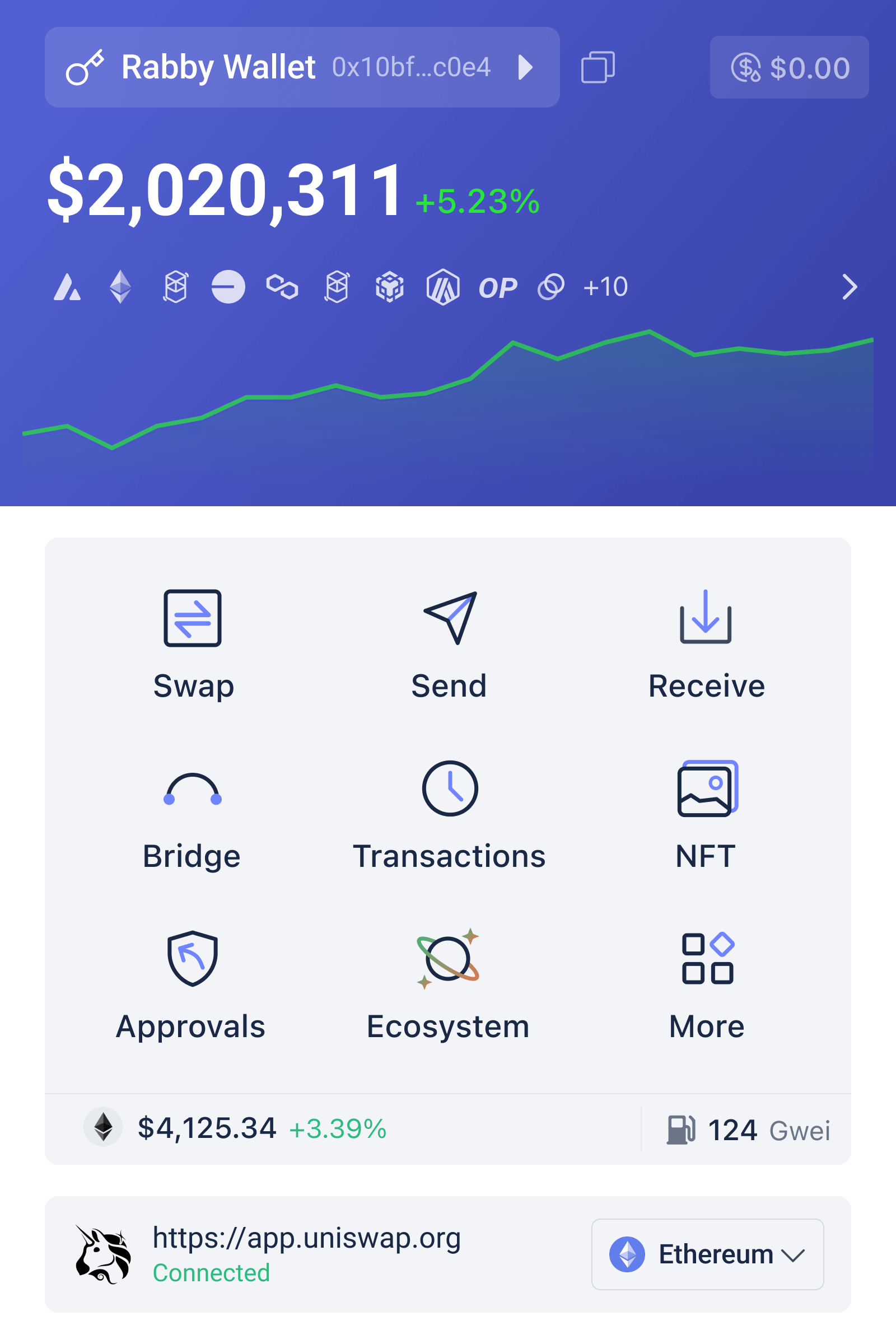
Rabby is built around this multi-chain reality. It supports more than 140 EVM networks, including Ethereum, Polygon, Arbitrum, Optimism, Avalanche, Base and BNB Chain. When a decentralised application requests a particular network, automatic network switching can remove one source of user error. The integrated swap function can scan venues such as Uniswap and 1inch, while bridge integrations such as LI.FI allow cross-chain transfers within the wallet interface.
Convenience, however, has a double edge. The more steps a wallet bundles together, the easier it becomes to overlook what is actually happening. An aggregator may find a better quoted route but still expose the user to several contracts. A bridge may simplify the interface while leaving the user dependent on the underlying bridge design, liquidity and settlement assumptions. The right question is not whether an interface is convenient, but whether it keeps the economic and security consequences legible.
That is where the rabby wallet extension can be useful for readers who want to examine a transaction before signing rather than relying solely on the dApp’s presentation. The value lies in the review layer: the wallet acts as an independent checker and does not itself create or alter the user’s transaction. Core signing functions can remain usable even if Rabby’s backend services are unavailable, although external data-dependent warnings and simulations may not always be equally complete in such circumstances.
Security is a chain of controls, not one warning screen
Rabby combines simulation with a security engine that checks contracts and addresses for signals associated with phishing, known exploits and potentially dangerous infinite approvals. This is a sensible design direction because DeFi losses rarely arise from one isolated interface problem. They often result from a chain of small assumptions: the website is genuine, the address is correct, the approval is limited, the selected chain is intended and the displayed result matches the action.
Yet users should interpret automated warnings as risk indicators, not as a universal audit. A clean result does not prove that a protocol is economically sound, that an upgrade administrator is trustworthy or that a bridge cannot fail. Conversely, a warning may reflect incomplete information rather than proof of maliciousness. Experienced users should treat the scanner as a second pair of eyes, while less experienced users should resist the opposite mistake: clicking through simply because the wallet has not displayed a red alert.
Non-custodial architecture changes the responsibility rather than removing it. Private keys are stored locally on the user’s device and are not sent to Rabby’s servers. Open-source code under the MIT licence also allows community inspection. These are meaningful transparency and custody properties, but they do not protect a user from a compromised computer, a leaked seed phrase, a fake download page or a deceptive signature. In Germany, where many users may manage meaningful long-term savings alongside experimental DeFi positions, separating custody risk from transaction risk is especially important.
Gas abstraction solves friction while adding a new dependency
Gas is another source of avoidable mistakes. A user may hold USDC on a network but no native token with which to pay the transaction fee. Rabby’s Gas Account is intended to address this by allowing network fees to be paid with stablecoins such as USDC, including across networks. This is a practical improvement because it reduces the need to maintain small balances of several native assets.
But “paying gas in a stablecoin” does not mean gas has ceased to be a cost or a technical dependency. The service must translate the stablecoin balance into the native fee required by the network, and that introduces an additional mechanism whose availability, pricing and supported conditions matter. Users should still check the effective fee, the relevant chain and whether the account has enough balance. Abstraction is helpful when it removes clerical work; it becomes risky when it hides the path by which the cost is produced.
The same principle applies to Rabby Points, earned through activities such as swaps, gas top-ups or referrals. A points programme may encourage engagement, but it should not be confused with a reduction in transaction risk or a guaranteed financial benefit. DeFi decisions should be justified by the transaction’s purpose, price and risk profile, not by the possibility of collecting loyalty points.
A practical review routine for multi-chain users
A useful decision framework is to review a transaction in three layers. First, check intent: is the selected network, protocol and asset exactly what you meant to use? Second, check effect: do the simulated balance changes, approvals and fee estimate match that intent? Third, check exposure: what remains true if the transaction succeeds but the market moves, a bridge is delayed or the approval remains active?
This framework catches a subtle but common misconception. Transaction simulation is not primarily a tool for predicting profit. It is a tool for comparing an intended action with an expected state transition. That makes it valuable for a large swap, a first interaction with a protocol and a routine approval alike. The apparently boring transactions can be the dangerous ones because users stop reading them.
Hardware-wallet compatibility with Ledger, Trezor and OneKey adds another control at the signing stage. It can protect the private key from some device-level threats, but it cannot make a harmful transaction harmless. A hardware wallet can securely sign the wrong message. The strongest setup therefore combines protected key storage with careful transaction interpretation, rather than treating either component as sufficient on its own.
What to watch as wallets become more intelligent
The recent positioning of Rabby in the Chrome Web Store reflects a broader direction: wallets are evolving from passive key managers into transaction interpretation layers for Ethereum and EVM activity. If this trend continues, users may increasingly judge wallets by how well they explain state changes, distinguish approvals from transfers and surface cross-chain dependencies.
The open question is whether better explanations will keep pace with more complex protocols. Automated simulation is strongest when the transaction’s effects are observable and the relevant contract state is available. It is less decisive where intent depends on off-chain services, governance decisions, oracle assumptions or delayed bridge settlement. The next meaningful improvement will therefore not simply be more warnings. It will be better explanations of uncertainty: what the wallet knows, what it inferred and what remains outside the simulation.
FAQ: Rabby Wallet and transaction simulation
Does transaction simulation make a DeFi transaction safe?
No. It can reveal expected balance changes, approvals and other effects before signing, but it cannot guarantee protocol solvency, market stability, bridge delivery or the absence of every exploit. Use it as a decision aid and combine it with contract, protocol and device hygiene.
Is Rabby a custodial wallet?
Rabby is presented as non-custodial: private keys remain locally on the user’s device rather than being transferred to Rabby’s servers. The user still controls the security of the device, recovery phrase and signing process.
Why does multi-chain support increase the need for simulation?
Each additional network, bridge, approval and contract creates another opportunity for confusion. Multi-chain support improves access, but it also increases the number of state changes a user must interpret. Simulation helps by translating part of that complexity into an expected outcome before confirmation.
The most useful way to think about Rabby is not as a magic shield, but as an attempt to restore context to a fragmented DeFi workflow. A wallet that shows what a signature is expected to change can make safer decisions easier. The final responsibility remains with the user, but informed refusal is far better than blind confirmation—and in multi-chain DeFi, that difference is often the decisive one.
